
Mail Us

michael.lessard@pastoralcareaz.org

Hosted By PCA

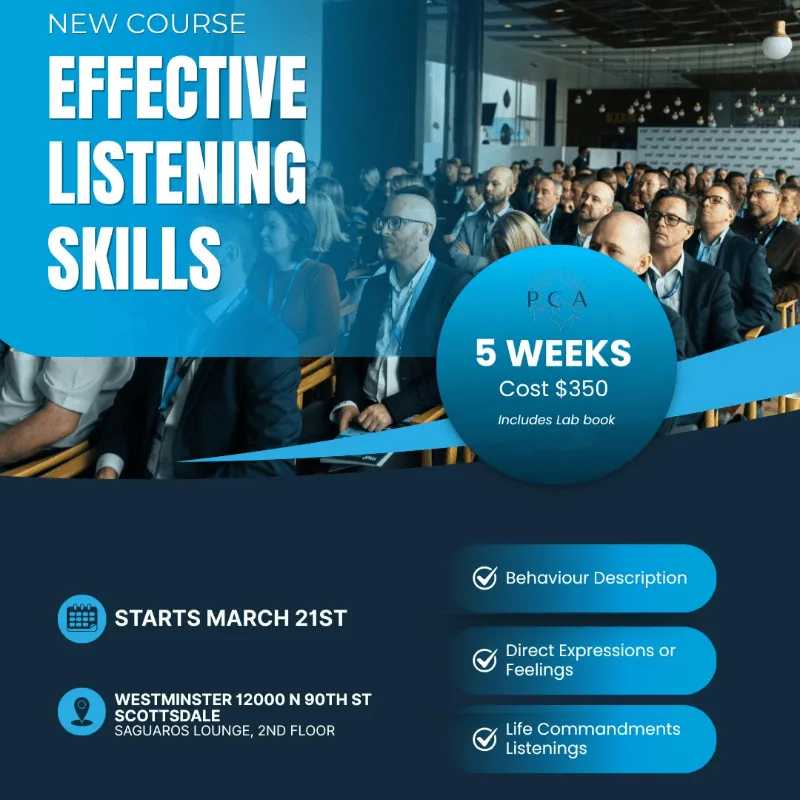
Effective Listening Skills

Strengthen your communication with our 5-Week Effective Listening Skills Course  designed to help you listen with clarity, empathy, and intention.

Why This Course Matters

The Way You Listen Shapes Every Relationship

Strong relationships begin with feeling heard. This 5-week experience helps you build healthier communication habits, reduce misunderstandings, and create deeper connection in everyday conversations.

Because when listening improves, everything improves. 

What You’ll Learn

Practical tools to listen with clarity and empathy, respond thoughtfully instead of reactively, and handle conversations with greater confidence and understanding.

BEHAVIOR DESCRIPTION:

Describing specific observable behaviors of another person (words, tone, and/or body movement) without making inferences such as accusations, judgments, or name-calling. 

DIRECT EXPRESSION OF FEELINGS:

Identifying and naming your own inner “I” emotional state.  

FOGGING:

Agreeing with the truth in the speaker’s critical statement(s). You agree with only that which is true for you.  

LIFE COMMANDMENTS LISTENING:

Listening for the commandments (hidden in the stories), that determine some of a person’s behaviors. They are intuitively obeyed and are not in the awareness of the person.  

NEGATIVE INQUIRY:

Coaching your critic to constructively criticize you in specifics (rather than in generalities). 

NEURO-LINGUISTICS:

Listening for and responding in the dominant mode of the speaker’s language. Also, observing the speaker’s eye movements for clues to the dominant mode (visual, auditory, or kinesthetic).  

PARAPHRASE

Restating, in your own words (not parroting), the content (words) of the speaker’s verbal communication. 

PERCEPTION CHECK:

Checking out YOUR PERCEPTION (guess) about what the speaker is experiencing (feelings/emotions) by responding to the messages that the person is sending you. These include words, voice tone, and body language (primarily tone and body language).  

PRODUCTIVE QUESTIONS:

Asking questions based on the speaker’s incomplete thoughts (deleted information), free information (unsolicited information), and/or responses to other questions that you have asked.  

STORY LISTENING:

Making a guess about the HIDDEN struggle (pain and/or joy) which is told through the stories the speaker shares with you. Listening for common themes in the stories to help you identify the issues with which s/he is dealing at the present time. 

STORY POLARIZATION LISTENING:

Listening for the polarities (opposites in the speaker’s stories) as a clue to his/her inner struggle. 

What You’ll Learn

Practical tools to listen with clarity and empathy, respond thoughtfully instead of reactively, and handle conversations with greater confidence and understanding.

Road Accidents

Provide corporate governance, helping clients manage responsibilitie of running a corporam responsibilities financial field.

Health Care Law

Provide corporate governance, helping clients manage responsibilitie of running a corporam responsibilities financial field.

Family Law

Provide corporate governance, helping clients manage responsibilitie of running a corporam responsibilities financial field.

Civil Litigation

Provide corporate governance, helping clients manage responsibilitie of running a corporam responsibilities financial field.

Real Estate Law

Provide corporate governance, helping clients manage responsibilitie of running a corporam responsibilities financial field.

Child Law

Provide corporate governance, helping clients manage responsibilitie of running a corporam responsibilities financial field.

Train with the best

BUILD COMPASSION THROUHG TRAINING